
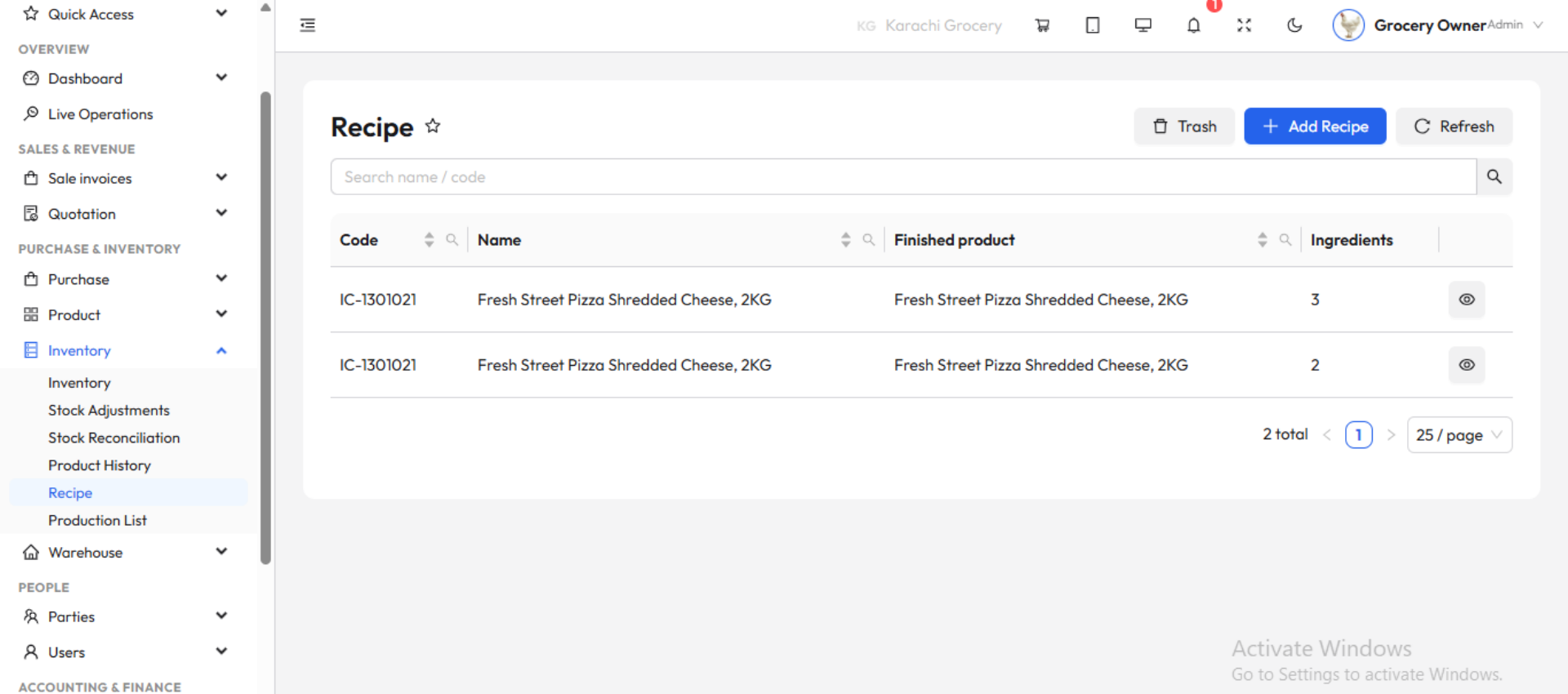
Give every item on your menu a recipe. Ingredients come off stock the moment a dish sells, your food cost stays current as supplier prices move, and the gap between what you should have used and what you did becomes visible.
Deductions happen at the moment of sale, not at closing.
Know which dishes make money at today's ingredient prices.
Expected usage vs actual — the gap is the problem.
Recipes tie your menu to your store room — so selling food and tracking food stop being two separate jobs.
Define exactly what goes into every dish — each ingredient, each quantity, each unit — so a plate is a known quantity, not a guess.
When a dish sells, its ingredients come off stock automatically. No end-of-day tally, no one manually subtracting chicken from a sheet.
See the real cost of every dish as ingredient prices move, and the margin it actually earns you — not the margin you assumed last year.
A large portion should not deduct the same as a small one. Give each size or variant its own recipe so stock stays honest.
Compare what your recipes say you should have used against what actually left the store. The gap is where your money is going.
Build a sauce or a base once, then use it across the menu. Change the recipe in one place and every dish that uses it updates.
A few hours of setup buys you stock accuracy for good.
List your raw materials with their units and purchase costs — flour in kg, oil in litres, chicken in kg.
Attach ingredients and quantities to each menu item, including its sizes and variants.
Every sale at the POS deducts the recipe from stock in the background — nobody has to remember
Track food cost, waste, and variance per dish, and re-price the items that are quietly losing money.

Over-portioning, waste, and drifting supplier prices rarely show up on a sales report — they show up months later as a bad month. Recipes make each of them a number you can point at.
Recipe management links every menu item to the raw ingredients it consumes. Once a dish has a recipe, selling it automatically deducts the right quantity of each ingredient from your stock — which means your inventory reflects reality without anyone counting at the end of the night.
Yes. As soon as an order is completed at the POS, the ingredients defined in that dish’s recipe come off your inventory. Stock levels stay current across the day rather than being reconstructed at closing.
Yes. Each size or variant of an item can carry its own recipe, so a large biryani deducts more rice than a regular one. Without this, portion sizes quietly distort your stock and your food cost.
Because zbillz knows the cost of every ingredient and the quantity each dish uses, it can show you the true cost and margin of every item on your menu. When supplier prices move, you can see immediately which dishes stopped being profitable.
Yes. Comparing the stock your recipes say should have been used against what physically left the store gives you a variance figure. A consistent gap points at over-portioning, waste, or theft — and tells you which item and which branch to look at.
Yes. You can build sub-recipes — a sauce, a marinade, a dough — and use them as components in other dishes. Update the sub-recipe once and every menu item built on it reflects the change.
Give your restaurant a fast, reliable point of sale system that connects your counter, kitchen, and reports. Start your 14-day free trial — no credit card required.
